
In the world of human-dog relationships, a fascinating drama unfolds, often overlooked – a story of love, connection, and utility. In our multi-part series, we delve into the depths of the relationship between humans and dogs, exploring historical backgrounds.
Dogs today are not just animals living in our homes; they often become family members, best friends, and confidants. The bond between a dog and its owner transcends a mere pet relationship; it is an emotional connection that deeply impacts the psyche of both parties. The question arises: “What role does the dog play in the life of humans, and how did this relationship evolve?”
The origins of the human-dog relationship can be traced back to the beginnings of human civilization approximately 20,000 to 40,000 years ago. The evolutionary partnership between humans and dogs took a crucial turn, especially during shared hunting activities. The role of dogs as hunting companions was essential for the community’s food supply. With their keen senses and cooperative nature, dogs not only helped secure prey but also fostered cohesion within the group. Dogs not only assisted in the search for food but also provided protection against predators. This mutual dependency not only shaped the evolutionary development of both species but also laid the foundation for the emotional connection that grew and thrived over millennia.
A significant indicator of the close bond between humans and dogs in this era is archaeological finds, especially graves where humans and their loyal companions were buried side by side. A fascinating example is the “Hund von Bonn-Oberkassel,” a Stone Age skeleton buried near its human companion. This suggests not only a purely functional relationship but rather a deeply felt bond. In some European cultures, especially in medieval and early modern Europe, dogs were considered companions and symbols of loyalty. In paintings and literary works of this time, dogs are often present as loyal companions of humans.
An international research team operating in the Altai region in Siberia discovered Bronze Age graves where both human and canine remains were buried together.
Another research project in North America, specifically near the Chesapeake Bay, revealed evidence of a deep-rooted relationship between indigenous people and dogs. In graves, dogs were found adorned with elaborate burial offerings. This illustrates that different cultures expressed their appreciation for these animals in similar ways.
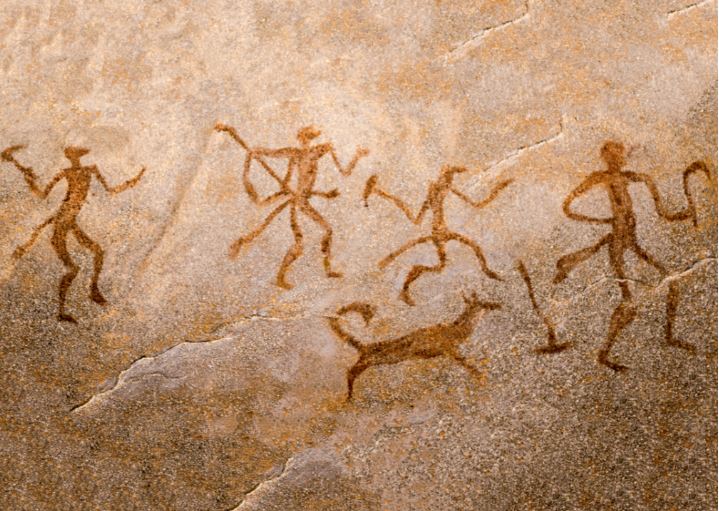
Similar evidence is found in the prehistoric caves of Bhimbetka in India, where cave paintings depict humans hunting alongside dogs. This example from South Asia illustrates that the partnership between humans and dogs was not limited to specific geographic regions but occurred globally.
These global research examples emphasize that the human-dog relationship was a deeply rooted and widespread connection that existed across continents and cultures. Archaeological findings and studies from various parts of the world confirm the universality of this relationship, showing that it is an integral part of human history and evolution.
The Agricultural Revolution, during which the role of dogs as working animals and protectors gained importance, extended roughly from 10,000 BCE to 3,000 BCE. This timeframe varies depending on the region and specific advancements in agriculture, but it provides a general temporal framework for this era.
The Agricultural Revolution also contributed to the development and diversification of dog breeds. Farmers and breeders began selectively breeding dogs to meet their requirements for work and protection tasks. This led to the emergence of different breeds with specialized abilities.
Different regions of the world have their unique stories and contributions to the human-dog relationship during this era.
The Agricultural Revolution marked not only a change in how food was produced but also had a significant impact on the role of dogs in human societies. Dogs became versatile work partners, their skills invaluable in both agriculture and protection.
A notable example of the adaptability of dogs is the emergence of herding dogs, especially the Collie breed. These intelligent animals were specifically bred for the task of herding and protecting flocks. Through targeted breeding, they developed distinct abilities to herd sheep and cattle. This symbiotic relationship between shepherds and their dogs continued not only in Europe but also in other parts of the world, such as Australia, where herding dogs were used to control livestock herds. These dogs not only aided in controlling livestock but were also crucial for protecting farms from predators.
During the Agricultural Revolution in Europe, dogs played a crucial role in various aspects of daily life. This era, roughly between the 8th and 19th centuries CE, was marked by significant changes in agriculture and social structures. With the transition from hunting and gathering to settled agriculture, dogs became indispensable work partners. Particularly, herding dogs like the Border Collie in Scotland or the Briard in France were bred to help control and herd livestock. Their intelligence and ability to understand commands made them valuable assets on farms.
Hunting dogs retained their significance during the Agricultural Revolution. They were used for hunting wild game, contributing to food security and controlling wildlife populations. Various breeds, such as the Pointer or the English Springer Spaniel, were specifically bred for their hunting abilities.
At a time when people began to establish settled communities, dogs were increasingly used as guard and protection animals. They guarded not only the homes of farmers but also agricultural properties against theft and predators. Dogs with a pronounced guarding instinct were highly valued and selectively bred.
Overall, the historical narrative of Europeans and dogs during the Agricultural Revolution illustrates the versatile use of these animals. Dogs were not only indispensable work partners but also close companions in the daily lives of people, adapting their functions to the changing requirements of society.
The protective aspect of the human-dog relationship during this period is particularly well-documented in ancient cultures. We will delve into this point in our continuation.
 OJgoldenretriever - Fashionist Dog Whisperer